
Are GPS Trackers Legal in Australia?
Yes. GPS trackers are legal to buy, own and fit in Australia, and tracking a vehicle you own and drive yourself is lawful everywhere in the country.
What the law regulates is whose vehicle you track.
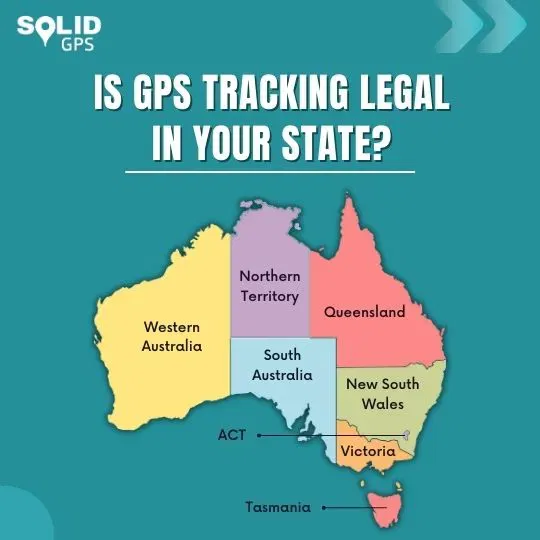
Five jurisdictions make this a criminal offence: New South Wales, Victoria, Western Australia, South Australia and the Northern Territory.
In each of them it is an offence to install, use or maintain a tracking device on a vehicle without consent. You need the consent of whoever is in lawful possession or lawful control of that vehicle.
That phrase, “the person in lawful possession or lawful control”, is the test the legislation actually applies. It is not the same thing as the person on the registration papers.
Queensland and Tasmania have no dedicated tracking device offence, though stalking provisions and privacy obligations still apply there.
Here is the state by state breakdown, the four situations people actually ask about, and the penalties when it goes wrong.
Contents
- Are GPS Trackers Legal in Australia?
- Can I Put a GPS Tracker on My Own Car?
- Is It Legal to Track a Partner or Ex Partner?
- Can Parents Track a Child’s Car?
- Is GPS Tracking Legal for Your Business?
- GPS Tracking Laws by State
- New South Wales GPS Tracking Laws
- Australian Capital Territory GPS Tracking Laws
- Northern Territory GPS Tracking Laws
- Western Australia GPS Tracking Laws
- Victoria GPS Tracking Laws
- South Australia GPS Tracking Laws
- Queensland & Tasmania GPS Tracking Laws
- What Are the Penalties for Illegal GPS Tracking?
- Best Practices for GPS Tracking Compliance
- Conclusion
Can I Put a GPS Tracker on My Own Car?
Yes, in every state and territory, provided no one else has lawful possession of it.
The surveillance devices legislation turns on the consent of the person in lawful possession or lawful control of the vehicle. Where that person is you, no offence arises at all.
This is the ordinary case for theft recovery, and it covers caravans, trailers, motorcycles, boats and work machinery just as much as it covers cars.
It stays lawful once your vehicle is stolen, because a thief is not in lawful possession of it. That is why location data from your own tracker is routinely handed to police during a recovery.
Lend a vehicle to a flatmate, an adult child, a partner or an employee and that person becomes the one in lawful possession while they have it. Tracking those trips covertly can be an offence even though the registration is in your name.
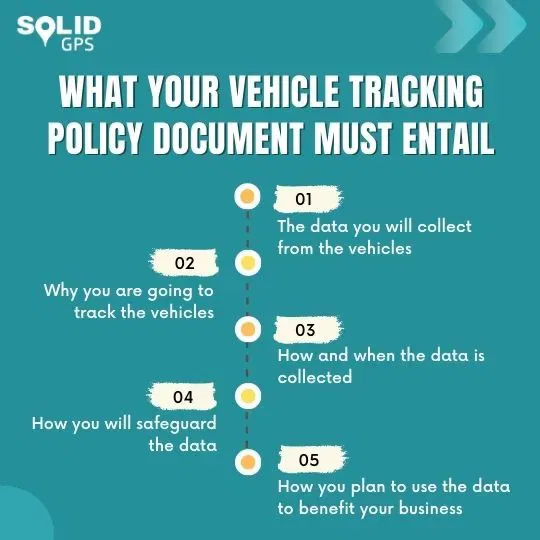
Tell anyone who drives the vehicle that a tracker is fitted, and where the vehicle is used for work, get that acknowledgement in writing.
Is It Legal to Track a Partner or Ex Partner?
No, and this is the single most common way people break these laws without realising it.
Fitting a tracker to the vehicle of a partner, spouse, ex partner or adult family member without their knowledge and consent is a criminal offence.
Marriage, a shared surname, a joint bank account and a jointly financed car do not amount to consent.
Where a car is jointly owned but the other person is the one driving it, they are the person in lawful possession. Theirs is the consent you need.
Queensland and Tasmania have no tracking device offence, so covert tracking of a partner is dealt with as unlawful stalking instead. Section 359B of the Criminal Code 1899 (Qld) expressly covers tracking a person’s movements without consent.
A court can refuse to admit evidence gathered this way, and the conduct itself tends to weaken the position of the person who gathered it.
If you believe a tracker has been placed on your own vehicle without your knowledge, contact police.
Can Parents Track a Child’s Car?
It depends on the age of the child and on who holds the vehicle.
Where you own the car, the child is a minor, and you are the one in lawful control of it, fitting a tracker is lawful. It is a common safety measure for families with a P plate driver in the house.
Most parents in that position still tell the child, because a device found later does more damage to trust than the tracking ever prevented.
That changes once the child is an adult, once the car is registered to them, or once the vehicle has been handed over as theirs to use. At that point they are the person in lawful possession, and their consent is required.
Tracking an adult child’s car covertly sits under exactly the same provisions as tracking any other adult.
Is GPS Tracking Legal for Your Business?
Yes, provided you meet the notice and consent obligations, which differ by state.
Businesses everywhere use GPS tracking to run their fleets, and the legislation was written to allow exactly that, provided the people being tracked know about it.
The Importance of Consent
Whatever state you are in, everything comes back to one word: consent.
Employers must inform employees that they are being tracked, and in the five states with a tracking device offence they need consent as well.
A verbal agreement is worth very little if it is ever disputed, so get it in writing and keep the record.
An employee assigned a company vehicle is the person in lawful possession of it under the surveillance devices legislation. Notice on its own therefore does not always discharge the obligation.
Express vs. Implied Consent
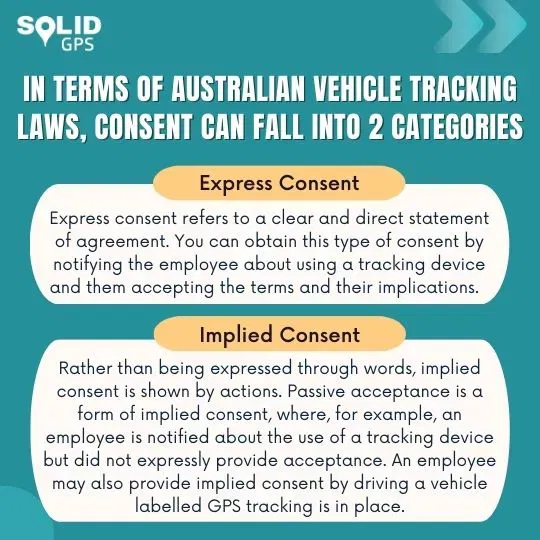
- Express Consent: A signed document or written agreement stating that the employee agrees to be tracked.
- Implied Consent: Consent that is assumed based on circumstances, such as an employee being made aware of tracking through policy documents and continuing to use the vehicle.
Not every state treats implied consent as sufficient, and some want an active agreement from the employee before anything is fitted.
The Privacy Act Layer
Location data that identifies a person is personal information. The Privacy Act 1988 (Cth) and the Australian Privacy Principles therefore sit on top of the state rules for most businesses turning over more than three million dollars a year.
Employee records are exempt where they relate directly to the employment relationship. The Office of the Australian Information Commissioner applies that exemption sparingly, and has recommended removing it.
Under the Privacy Act, collection must be reasonably necessary for a genuine business function. That is far harder to argue for tracking outside working hours than during a shift.
GPS Tracking Laws by State
Each Australian state has its own surveillance devices legislation governing GPS tracking, and the differences between them are real.
Most states set their maximum fines in penalty units rather than dollars. A penalty unit is a fixed dollar amount the jurisdiction sets, so every fine across every statute can be raised at once without rewriting any of them.
The values as at September 2026:
- NSW: $110, fixed by legislation rather than indexed.
- Victoria: $209.10 for 2026-27, reset every 1 July.
- Northern Territory: $194, indexed to Darwin CPI.
- ACT: $160 for an individual.
Western Australia and South Australia state their penalties in dollars instead, so those figures stay put until Parliament changes them.
Here is how they shake out.
New South Wales GPS Tracking Laws
New South Wales is the only jurisdiction where two separate statutes apply to a work vehicle at the same time.
- Section 9 of the Surveillance Devices Act 2007 (NSW) makes it an offence to knowingly install, use or maintain a tracking device on a vehicle without consent. That consent must come from the person in lawful possession or having lawful control of it, and may be express or implied.
- The maximum penalty is 100 penalty units or 5 years imprisonment, or both, and 500 penalty units for a corporation.
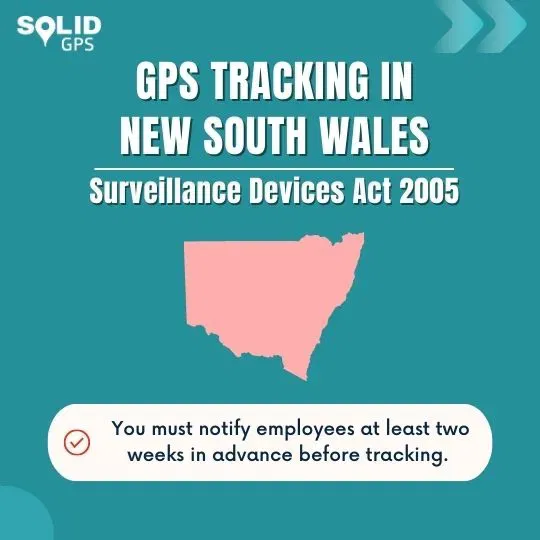
- The Workplace Surveillance Act 2005 (NSW) separately requires at least 14 days written notice to an employee before tracking surveillance begins.
- That notice must state the kind of surveillance, how it will be carried out and when it starts. It must also say whether the surveillance is continuous or intermittent, and whether it runs for a set period or is ongoing.
- A tracked vehicle must also carry a clearly visible notice that tracking surveillance is in place, and new employees must be notified before they start.
- Employer and employee can agree in writing to a shorter notice period, and covert tracking is lawful only under a covert surveillance authority issued by a magistrate.
Notice alone is not enough in NSW, because the Surveillance Devices Act still requires the consent of the person holding the vehicle. A written acknowledgement signed by the employee satisfies both statutes at once.
The New South Wales Covert Stalking Offence
New South Wales is adding a third layer aimed specifically at hidden trackers.
It closes a gap in the old offence. Stalking required the victim to fear physical or mental harm, and nobody can meet that threshold while the tracking is still secret.
The Crimes (Domestic and Personal Violence) and Other Legislation Amendment Bill 2026 was introduced on 5 May 2026. It creates an offence of covert stalking carrying up to 50 penalty units or 5 years imprisonment.
It also widens the definition of stalking to cover directing someone else to do it. A second offence covers promoting the unlawful use of a surveillance device when advertising it for sale.
It is not law yet.
The schedules carrying the covert stalking and advertising offences commence on a day to be appointed by proclamation, not on the date of assent. No proclamation had been made as at September 2026.
Australian Capital Territory GPS Tracking Laws
The ACT follows an approach similar to NSW under the Workplace Privacy Act 2011 (ACT), which covers optical, tracking and data surveillance devices but not listening devices.
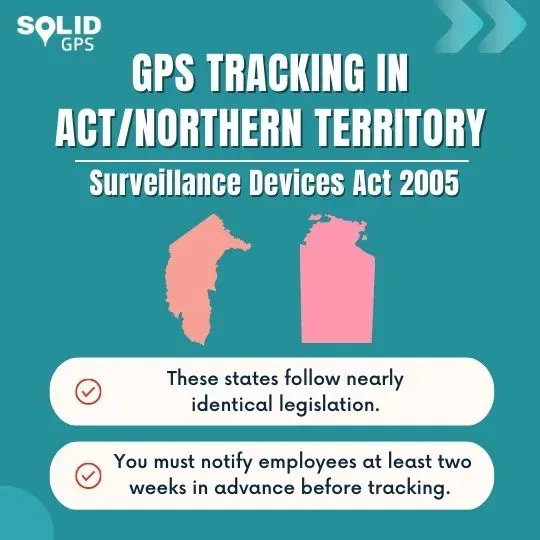
- Employers must give at least 14 days notice before surveillance of a worker starts, and must consult employees in good faith beforehand.
- The law focuses on transparency, so employees must understand the nature of the tracking being carried out.
- Maximum penalties for the surveillance offences run from 20 to 50 penalty units each. Conducting tracking surveillance without complying with the notice requirements sits at the lower end.
- Covert surveillance requires a covert surveillance authority from a court.
Northern Territory GPS Tracking Laws
The Surveillance Devices Act 2007 (NT) governs tracking in the Northern Territory.
- Section 13 makes it an offence to install, use or maintain a tracking device without consent. That consent must come from the person in lawful possession or having lawful control of the vehicle.
- The maximum penalty is 250 penalty units or 2 years imprisonment.
The NT has no separate workplace surveillance statute, so the Surveillance Devices Act and the Privacy Act carry the whole load there.
Western Australia GPS Tracking Laws
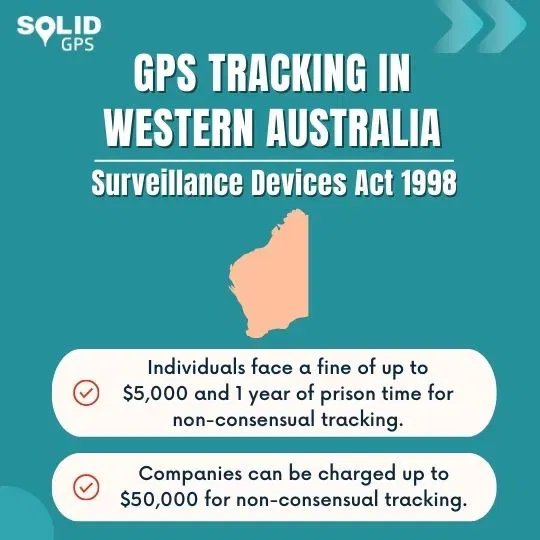
Western Australia regulates tracking devices under section 7 of the Surveillance Devices Act 1998 (WA).
- Employers must obtain active consent from the person in lawful possession of the vehicle before tracking it.
- Simply notifying employees is not enough in WA, because they must actually agree to the tracking.
- The maximum penalty for an individual is $5,000 or 12 months imprisonment, or both.
- The maximum penalty for a body corporate is $50,000.
WA is one of the few states that still expresses its penalties as fixed dollar figures rather than penalty units. The numbers above do not move with indexation.
Victoria GPS Tracking Laws
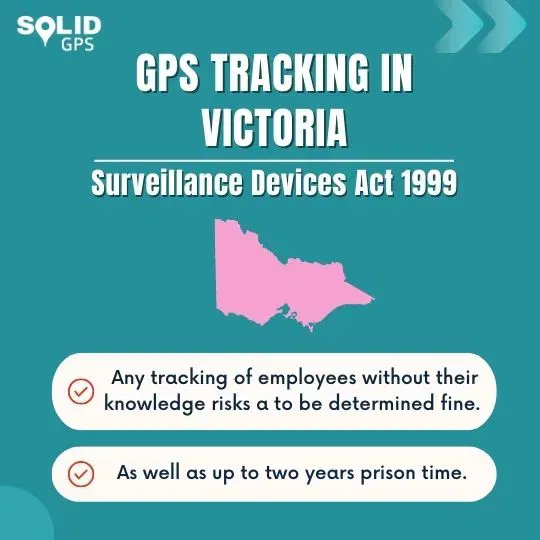
Victoria deals with tracking devices under section 8 of the Surveillance Devices Act 1999 (VIC).
- Businesses must obtain consent before installing a tracking device in a vehicle another person lawfully possesses or controls.
- The maximum penalty for an individual is 240 penalty units or 2 years imprisonment, or both.
- The maximum penalty for a body corporate is 1200 penalty units.
Victorian penalty units are indexed each financial year, so check them against the current value rather than a dollar figure quoted in an older article.
South Australia GPS Tracking Laws
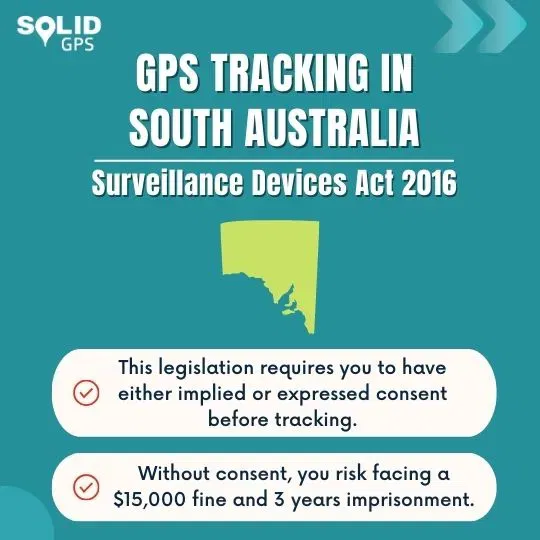
South Australia regulates tracking devices under section 7 of the Surveillance Devices Act 2016 (SA).
- It is an offence to knowingly install, use or maintain a tracking device to determine the location of a vehicle without consent. That consent may come from the owner, or from a person in lawful possession or lawful control of it.
- The maximum penalty is $15,000 or 3 years imprisonment.
South Australia is the only state that names the owner alongside the person in possession, which makes an owner driver arrangement slightly easier to justify there.
Queensland & Tasmania GPS Tracking Laws
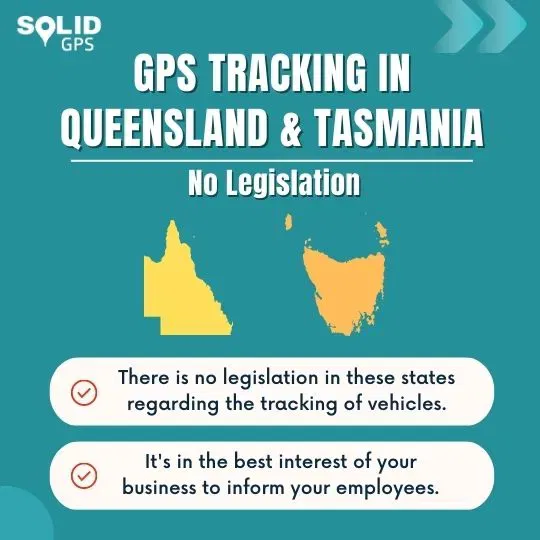
Queensland and Tasmania have no dedicated tracking device offence, which is a gap in their legislation rather than a deliberate permission.
- The Invasion of Privacy Act 1971 (Qld) covers listening devices only, and Queensland has never enacted a surveillance devices act of the kind the other states have.
- Section 359B of the Criminal Code 1899 (Qld) covers unlawful stalking, and it expressly includes monitoring or tracking a person’s movements without consent.
- The Listening Devices Act 1991 (Tas) likewise regulates listening devices only. Tracking devices fall under the Police Powers (Surveillance Devices) Act 2006 (Tas), which applies to law enforcement acting under warrant.
- The Queensland Law Reform Commission recommended a dedicated surveillance devices act for the state in its Report 77, so this position may not hold.
Businesses in QLD and TAS therefore have more flexibility on the surveillance side, while remaining fully exposed on the stalking and privacy side.
The sensible approach in both states is to meet the NSW standard anyway, because that is roughly what any future legislation will ask for.
What Are the Penalties for Illegal GPS Tracking?
Maximum penalties for tracking a vehicle without consent, as at September 2026:
- NSW: 100 penalty units ($11,000) or 5 years imprisonment, 500 penalty units ($55,000) for a corporation.
- Victoria: 240 penalty units (about $50,000) or 2 years imprisonment, 1200 penalty units (about $251,000) for a body corporate.
- South Australia: $15,000 or 3 years imprisonment.
- Northern Territory: 250 penalty units ($48,500) or 2 years imprisonment.
- Western Australia: $5,000 or 12 months imprisonment, $50,000 for a body corporate.
- ACT: 20 to 50 penalty units ($3,200 to $8,000) for the workplace surveillance offences.
- Queensland and Tasmania: no tracking device offence; covert tracking is prosecuted as unlawful stalking.
NSW aside, these values are indexed each July, so the dollar equivalents above move every financial year.
The criminal penalty is rarely the whole cost. A court can refuse to admit unlawfully obtained location data, and a business can also face a determination from the Office of the Australian Information Commissioner.
Best Practices for GPS Tracking Compliance
The practical steps that keep a business on the right side of these laws:
- Obtain written consent from whoever holds the vehicle before installing a GPS tracking device.
- Give 14 days written notice before tracking starts, and keep a copy of it.
- Maintain clear records of consent and notifications for as long as the tracking runs.
- Display visible signage in the vehicle indicating that tracking is in place.
- Write down the business purpose, the retention period, and who is allowed to see the data.
- Limit tracking to working hours wherever the business case allows it.
- Regularly update tracking policies in line with changing laws.
Conclusion
GPS tracking laws in Australia all turn on the same question: who lawfully possesses or controls the vehicle, and have they agreed to being tracked.
Tracking your own vehicle is lawful everywhere, and tracking a partner’s vehicle is criminal everywhere. Tracking an employee’s work vehicle is lawful once you have given notice and obtained written consent.
This article is general information rather than legal advice, and it was last reviewed in September 2026 against the legislation then in force.
Running vehicles other people drive? Solid GPS scales to any fleet size on one tracker, one price, with live location for every vehicle. Trusted by 30,000+ vehicle owners.